The Fox, originally called the Fox and Duck, was actually situated across the
road from the current site, but in the 1920s the brewers Joules, based in Stone
in Staffordshire, decided to get a grip and do things properly, and a
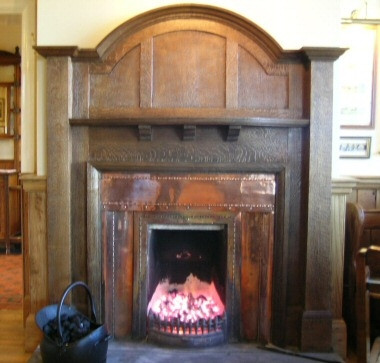
purpose-built pub was commissioned. The wooden fireplace in the front bar is an
original Joules fireplace, the design of which was used in many of their pubs.
Original Joules fireplace
Joules were taken over by Bass, who also had bought the Mitchell and Butler
brand, so the Fox and Duck eventually became a Mitchell and Butlers pub.
Strangely enough, even though the pub moved to its present site over 80 years
ago, the current Ordinance Survey map still shows the 'PH' symbol in its
original position over the road.
In the 80's the Monopolies and Mergers Commission compelled large breweries to
sell off much of their pub estates, and the Fox and Duck was sold into the free
trade.
Shortly afterwards, under the ownership of Arthur Foxcroft, the pub was
significantly extended to the left hand side as you look at it, to give a
function room with bedrooms above. The original building ended on the left hand
wall of the front bar, so everything beyond that was the new addition. It was
run as a small hotel with ten letting bedrooms, and had an excellent reputation for food.
In July 2001, the Fox and Duck was bought by Derek and Sandra Longstaff.
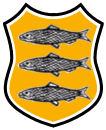
They wanted to make a fresh start, so they renamed it the Three Fishes, after the heraldic symbol for Newport.
The Three Fishes as a symbol came about as a result of a visit by Henry 1st
to Newport in the 12th Century. At that time, the main industry of the town was
fishing the three meres, and they were anxious to retain their charter. Henry
agreed to this with the caveat that every time he came through the town, he
would be presented with three fishes.
Although the layout of the medieval town is still obvious, not many buildings
of the time remain. One year before London's Great Fire, Newport had one of its
own. Most of the town was destroyed by fire in 1665.
The symbol has been adopted by the Newport Rugby and Cricket Clubs as well as
the local school, so the Longstaffs had half the town marching around with free
advertising on their shirts, a shrewd bit of marketing if ever there was.
When we took it over in January 2004 we couldn't get stuck into it as we were
busy with the Combermere in Burleydam, but when that opened in July we got
straight on with the new pub without catching breath.
Some local bits and pieces
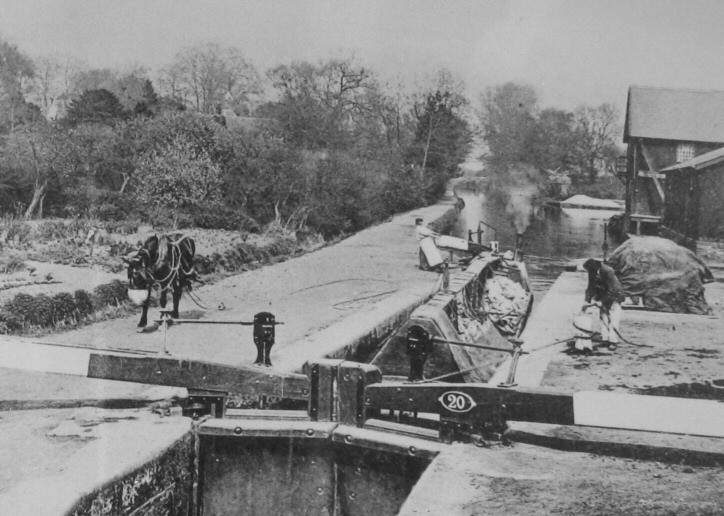
A former lord of the Chetwynd Aston manor was the Duke of Sutherland, and
his vast industries around Donnington supplied most of the coal for Newport by
canal to a coal depot located in the parish. A driveway from his house at
Lilleshall had its entrance between Pave Lane and the village of Chetwynd Aston.
Shortly before the French revolution, the owner of the big house at
Chetywnd sold the place in a big hurry, as he believed the world was about to
end. Quite how this was going to improve the situation was not known - perhaps
he though he was getting one over on the purchaser.
Charles Dickens (1812- 1870) stayed at The Bear Hotel in Newport, now
called Beaumaris House and part of the Grammar School. Chetwynd House was
formerly the home of Elizabeth Parker, the recluse on whom Dickens modelled Miss
Havisham in Great Expectations (1861).
Chetwynd Aston was once known as Field Aston, Since the building of the
Newport bypass, the village of Chetwynd Aston has been left in comparative
peace, and today, especially away from the main road through the village, it is
a very pleasant spot.
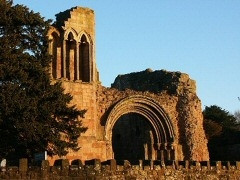
Just next door to the pub are the beautiful ruins of Lilleshall abbey,
including a fine Norman west door and part of the front, and considerable
remains of the church and some domestic buildings. The abbey was founded in
1143, under charter from King Stephen, by Richard de Baumes or Belmeis, dean of
St Alkmund, Shrewsbury. It was built for Augustinian canons, who were brought
from Dorchester Abbey, Oxfordshire. The last abbot of Lilleshall, John Cockerel,
was a fairly serious chap, and Henry VIII had him executed for his pains.
Predictably, there are a number of ghost stories associated with the abbey,
notably
this one from a local photographer of historic buildings, Lawrence
Clout.
Chetwynd-Talbot was the family name of the Earls of Shrewsbury, who were
also the Earls of Talbot. The family seat was Alton Towers before it became the
massive theme park. Alton Towers' garden was begun in1814 by the eccentric 15th
Earl of Shrewsbury, of whom J. C. Loudon (who was consulted on design features)
relates that he consulted every artist, only to avoid 'whatever an artist might
recommend'.
Under the patronage of the Earl of Shrewsbury, Clément Talbot Ltd was founded
in 1903 to import the popular French Clément car into Britain. The famous
automobile brand Talbot grew out of this company.
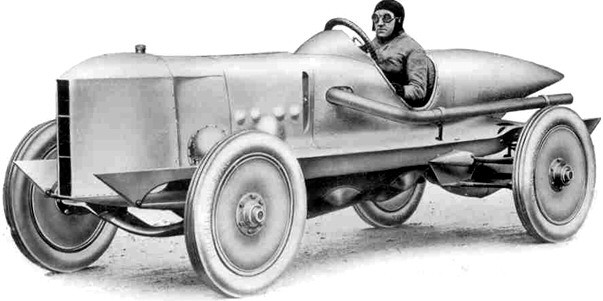
Its greatest success occurred in 1913 when Percy Lambert drove a 25hp Talbot
100 miles within an hour at Brooklands race track in Surrey, the first truly
100mph car.
A 1913 Talbot pilotted by Percy Lambert